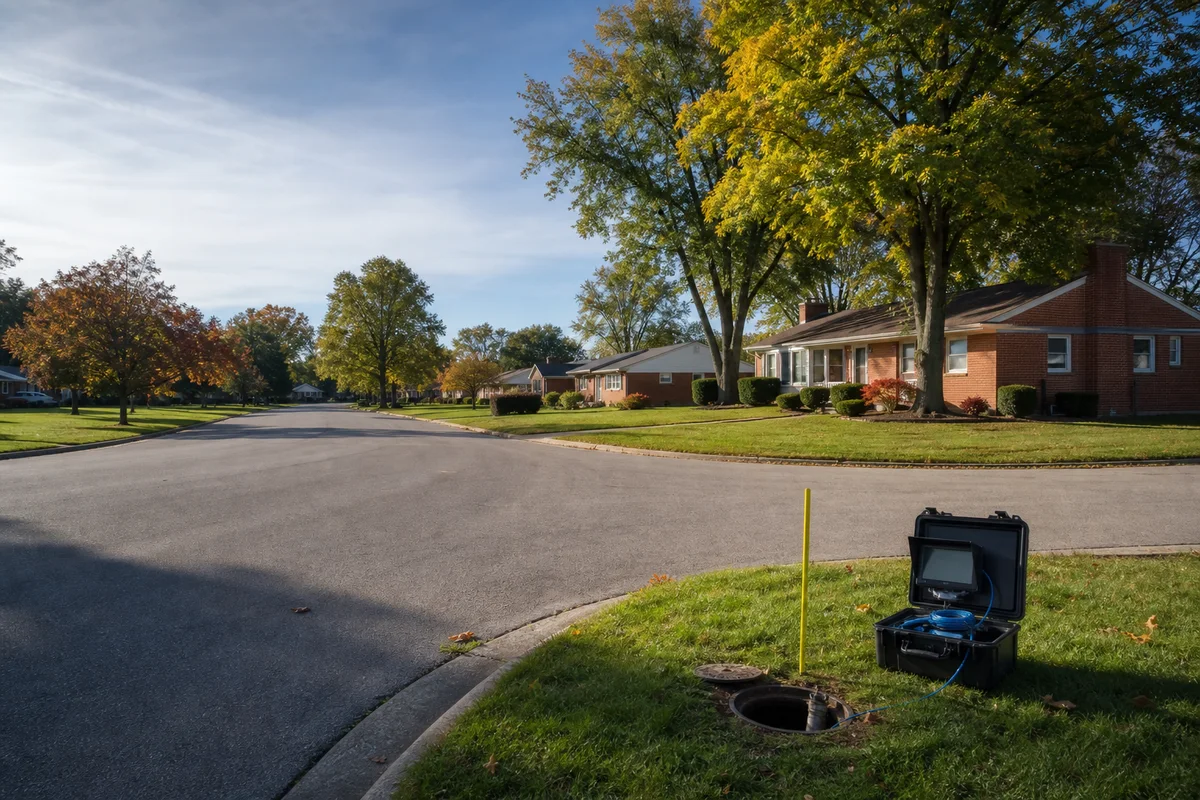
Livonia Craft Trenchless provides homeowner decision guides and quote routing for trenchless sewer repair in Redford, about 5 miles from Livonia; The 1940s bungalow belt contains some of the corridor’s older private laterals, with original clay and established utility routes on Detroit-supplied service.
The local setting is useful when it changes an address-level question, but it does not prove the material, condition, ownership, route, defect or serving system of one private sewer lead, so the property record still needs to confirm the utility, access point, camera direction, measured stations, visible limits and current permit authority before a repair method is selected.
Redford homes need an address-first sewer record
Begin by identifying whether the concern involves the interior building drain, exterior private lateral, septic building sewer, shared private pipe, public main or storm-water route; then record whether the symptom is a slow fixture, building-wide backup, wet-weather event, exterior settlement, odor, recurring roots or a transaction inspection finding, because those observations point to different parts of the system without diagnosing any one of them from a distance.
Use the Redford municipal website as the first jurisdictional reference and Wayne County environmental permit guidance for the relevant county context; public maps and records can identify utility districts, parcels, roads, drains or contact points, but the private route still needs its own camera inspection, station log and surface locations before those public records become useful to the scope.
Ten local planning markers for Redford
The 1940s bungalow belt contains private laterals that may predate several generations of interior plumbing updates.
Mature street trees make individual clay joints and their exact root-entry stations worth recording.
Compact first-ring lots can narrow equipment placement even when the lateral is short.
Detroit-supplied utility service does not transfer maintenance responsibility for the private building sewer.
A Redford route may combine interior cast iron, exterior clay, and a later plastic repair.
A surface location beside the tree lawn is more useful than a video timestamp alone.
The township boundary should appear correctly on permits and service records.
Postwar block repetition does not prove that neighboring laterals share the same defect.
A Redford scope should identify driveways and established walks before access is selected.
Closing footage should include both sides of every repaired clay joint.
Redford permits and responsibilities for sewer work
Ask the enforcing agency whether the planned work requires a plumbing permit, building-sewer permit, excavation approval, right-of-way coordination, inspection or separate county review, and record who pulls the permit, who schedules inspection, what must remain exposed, which tests or footage are required and which signed record closes the file; the answer can change with the address, ownership boundary, connection point, work length, surface opening and affected public facility.
Separate private responsibility from public context
Livonia states that the private sewer lead and its connection to the main are the homeowner’s responsibility while the city maintains the sanitary main, but nearby municipalities can use different wording, districts or connection rules; confirm the boundary for the Redford address and read any wet-weather program, creek-flood history or public rehabilitation record beside the private inspection without turning either record into proof for the other.
What makes trenchless sewer repair different in Redford
Material era, lot width, mature trees, finished surfaces, clay-rich soil, groundwater, utility density, route length and municipal boundaries can alter inspection and access priorities without selecting lining, bursting, spot repair or excavation by themselves; the camera log should therefore name station zero, direction, materials, diameter, transitions, defects, standing water, visibility limits and the end of the inspected route, with surface locations for every observation that could change the method or work zone.
Connect the local condition to method prerequisites
CIPP lining needs a cleanable host pipe with usable geometry, pipe bursting needs compatible old material plus displacement room, safe utility clearance, practical pits and manageable bends, a spot repair needs sound pipe documented on both sides, and excavation remains a valid comparison when those prerequisites are missing; the proposal should name the observed fact that qualified its method rather than relying on neighborhood age, soil or the marketing label no-dig.
Camera inspection for a Redford property
Preserve the complete recording from the access opening to the documented survey limit, keep an obstructed first pass separate from any post-cleaning pass, attach still images to measured stations, tie important stations to foundations, walks, drives, cleanouts, curbs or property boundaries and state what the camera cannot directly prove, including exterior soil support, precise grade, hidden utility clearance and the condition beyond a collapse it cannot pass.
Sewer repair options available around Redford
Use the same station record to compare trenchless pipe lining, pipe bursting, sewer spot repair, Orangeburg replacement and excavation, while treating emergency flow restoration as a separate scope when necessary; the least disruptive label is not automatically the least expensive or most durable choice when cleaning, access, connections, survey limits or restoration are excluded.
Price the entire Redford work zone
Compare cleaning, locating, access, pits, interior protection, branch treatment, utilities, permits, inspection, pipe method, closing footage, spoil handling, concrete, paving, landscaping and other restoration as separate lines, and ask what condition triggers a change order if the camera cannot pass, the material changes, the route bends, groundwater enters, a utility conflicts or the public connection differs from the initial assumption; local context is not a price multiplier by itself because cost follows the measured work zone.
Records to keep after sewer work in Redford
Store the before-and-after footage, station map, written scope, permits, inspection records, material or product information, invoices, restoration terms and every remaining survey limitation with the property file; the closing camera should identify the same route and stations used to approve the work, show repaired endpoints, transitions, branch reopening where relevant and the unaltered pipe around them, because visible flow alone is not a complete structural closeout.
Request repair options for Redford
Send the street, property type, system type if known, symptoms, rainfall timing when relevant, previous work and available footage through the request form; this website provides planning information and routes requests, while a qualified local provider must inspect the property and confirm current permit requirements before issuing a final scope.
Primary references for this Redford guide
- Redford municipal website
- Wayne County environmental permit guidance
- City of Livonia Water and Sewer
Frequently asked
01Is every Redford property connected to the same sewer system?
No. Confirm the serving utility and private connection for the exact address before comparing repair methods or permit paths.
02What should a Redford sewer camera record include?
Keep the access point, direction, complete video, measured defect stations, pipe materials, visibility limits, surface locations, and a written explanation of any recommended next step.
03Does an older house automatically need a full sewer replacement?
No. Housing era is a reason to inspect the line carefully. Current material, geometry, defects, access, and serviceability determine the method.
04Can trenchless work avoid every surface opening?
No. Connections, access, pits, fittings, utilities, inspection, or restoration may still require controlled openings.