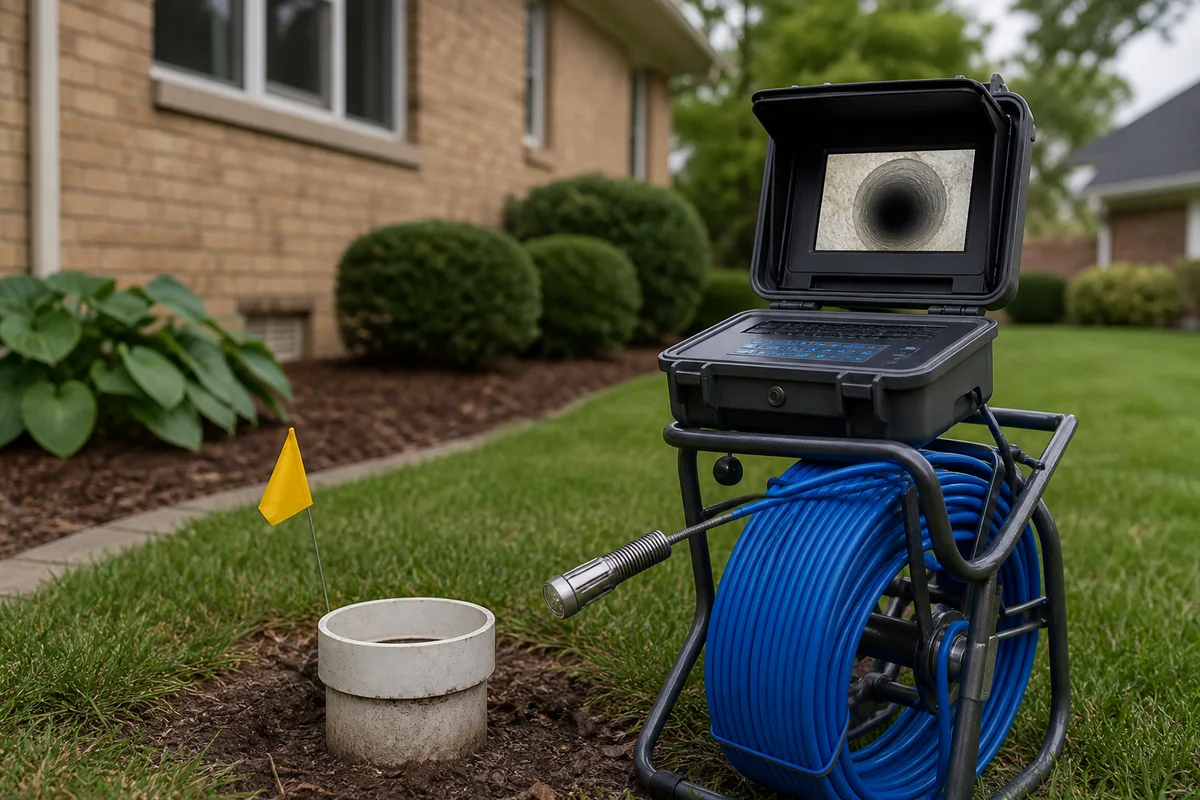
Livonia Craft Trenchless is a Livonia, Michigan information and quote-request resource focused on camera-led sewer decisions. A sewer camera converts symptoms into a distance-based record only when the access point, direction, counter, material, defects, visibility limits, and surface locations are preserved.
The City of Livonia reports that it maintains about 540 miles of sanitary sewer and that the private sewer lead and its connection to the main remain the homeowner’s responsibility. That boundary makes a precise defect station and a clear ownership record essential before sewer camera inspection is proposed.
Establish station zero and camera direction
Start with station zero. Record the access opening, direction of travel, pipe material, approximate diameter, distance counter, visibility, and every point where the material or geometry changes. The continuous recording should show the approach to each defect, not only a screenshot of the worst frame.
Useful footage separates the first obstructed pass from any post-cleaning pass and attaches still images to measured stations rather than isolated screenshots. If deposits, standing water, roots, scale, or an obstruction hide the wall, label the first pass as limited. A post-cleaning pass is a different record and should not be confused with the first survey.
Convert the video into a station log
For each observation, write the distance, clock position where useful, surrounding sound-pipe condition, severity, and the action needed to qualify it. Surface-locate the stations that can alter access, method, cost, or restoration. Photograph the marks beside fixed references such as the foundation, cleanout, walk, drive, curb, or property boundary.
The camera operator should state the end of the inspected route and why the survey stopped. A line that could not be viewed to the connection remains partly unknown, even when the visible footage looks clear.
Distinguish deposits from pipe-wall damage
Use one condition record to compare camera inspection, CIPP lining, pipe bursting, spot repair, and controlled excavation where those choices remain relevant. The recommendation should explain which prerequisite each option satisfies or fails.
A camera does not directly measure outside soil support, exact pipe slope, buried utility clearance, or the condition beyond an impassable collapse. Method limits belong in the written scope. If later cleaning, locating, or access work changes a qualifying fact, the proposal should pause at a named decision point rather than changing the method informally in the field.
Put preparation and access into the method comparison
Preparation is part of the repair, not a side task. Compare cleaning, descaling, root cutting, locating, pits, interior protection, bypass or flow control, branch treatment, utility marking, inspection, and restoration on the same line-by-line sheet. A lower method price can omit a required preparation item and still produce a higher final cost.
Equipment placement also matters in Livonia’s established residential blocks. Mature trees, driveways, patios, fences, attached garages, finished basements, and long setbacks can control the work zone even when the buried defect is short.
Surface-locate the important defect stations
Wayne County publishes separate guidance for connections or alterations involving county sanitary interceptors, while Livonia’s Inspection Department handles local plumbing permits and inspections. A private residential repair is not automatically the same as a county-interceptor project. Confirm the current authority for the actual address and proposed scope before work begins.
The written plan should identify who obtains permits, who schedules inspections, what needs to remain visible, and what closes the permit. It should also distinguish the private building sewer from the public main and any shared or commercial piping on the parcel.
Check the route against Livonia utility information
Livonia’s public GIS resources include sanitary sewer, storm-drain, water-main, parcel, and right-of-way layers. Those records can provide context, but they do not replace private locating or camera evidence. A map line is not proof of private material, depth, or condition.
Before ground is opened or pipe is displaced, complete utility marking and verify sensitive crossings. A presumed straight lateral can include bends, repairs, or an unexpected connection that changes the practical method.
Cost drivers for sewer camera inspection in Livonia
Cost follows the measured work zone. Important variables include footage, depth, diameter, access, cleaning, material, branch count, equipment position, soil and groundwater, utility conflicts, permits, inspection, traffic control, interior protection, surface restoration, and the certainty of the camera record.
The City of Livonia publishes plumbing permit information and fee schedules, but a permit line is only one part of the total scope and current fees should be confirmed at application time. Use the Livonia sewer repair cost guide to compare inclusions rather than treating a web page as a remote property quote.
Compare exclusions and change conditions
Ask each proposal to identify allowances, unit prices, owner responsibilities, exclusions, and the evidence that would trigger a change. The comparison should say what happens if the camera cannot pass, cleaning reveals a larger defect, the route is not where expected, a utility conflict appears, or the selected method cannot reach the planned endpoint.
A complete bid also names who restores concrete, pavement, landscaping, walls, floors, or fixtures. Separating the pipe method from restoration makes the apparent price easier to understand but does not remove that work from the property decision.
Preserve the complete recording and limits
Closeout should refer to the same access point and defect stations used to approve the work. Preserve the full post-work camera pass or commissioning test, permit and inspection record, product or replacement-pipe information, surface restoration notes, and any limitation that remains beyond the repaired section.
If the property is sold later, those records help the next owner distinguish documented work from a vague statement that the sewer was repaired. For a managed building, the same file supports maintenance planning and a future comparison when another section is inspected.
Request sewer camera inspection options
Use the request form to send the Livonia-area property location, system type if known, symptoms, prior repair information, and any available footage. This website provides planning information and routes quote requests. A qualified local provider must inspect the property before issuing a final scope.
Primary references for this sewer camera inspection guide
- City of Livonia Water and Sewer
- Wayne County environmental permit guidance
- U.S. EPA trenchless rehabilitation fact sheet
Frequently asked
01What evidence should come before sewer camera inspection?
Keep the complete inspection record, access point, direction, measured stations, material and diameter notes, visible defects, survey limits, and the reason alternative methods were ruled in or out.
02Can sewer camera inspection avoid all excavation?
No. Connections, access, collapsed pipe, fittings, utilities, route changes, inspection requirements, or restoration may still require a controlled opening.
03Who maintains the private sewer lead in Livonia?
The City of Livonia states that it maintains the sanitary main while the individual sewer lead and its connection to the main are the homeowner responsibility.
04What records should remain with the property?
Retain the unedited before-and-after footage, surface locations, written scope, permits, inspection signoffs, product or replacement material information, invoices, and restoration terms.