Livonia Craft Trenchless provides homeowner decision guides and quote routing for trenchless sewer repair in Clawson, about 21 miles from the Livonia hub. This compact Oakland County city sits between Madison Heights, Royal Oak and Troy. Its dense postwar brick ranch blocks make sewer planning a close study of individual lots: a driveway, front walk, basement access or neighboring structure can affect the work zone even when the damaged pipe is short.
Original clay or cast-iron laterals are part of the local inspection context, but a house’s appearance cannot identify its buried pipe. A remodeled Clawson ranch may retain an older exterior lead, while another property may have a replacement section joined to original material. Start with recorded evidence before deciding whether lining, bursting or a smaller repair fits.
Build an address-first sewer record in Clawson
Write down the property address, building use, symptoms, affected fixtures and timing. Separate a single slow drain from a building-wide backup, and note whether trouble follows rainfall or returns after cleaning. Include earlier excavation, additions and any available inspection footage. These observations help define the investigation without proving that the exterior lateral is broken.
Ask the City of Clawson to confirm the serving system, connection information available for the property, and the boundary between private and public responsibility. Identify whether the problem concerns the building drain, private lateral, shared connection or another drainage route. A nearby city boundary or street name cannot settle that question.
Keep a simple property sketch with the inspection access, direction of travel and measured distance to each finding. For a compact Clawson lot, mark the house, walk, driveway and curb so that a proposed opening can be understood before equipment arrives. Describe unverified routes as unverified rather than drawing a straight line to the street and treating it as an established connection.
What Clawson’s postwar blocks change about planning
Repeated ranch floor plans do not mean repeated sewer layouts. Basement alterations, rear additions and previous repairs can change access or introduce material transitions. On Clawson’s closely spaced residential blocks, checking whether a camera can enter through an existing cleanout may materially change the amount of interior protection or exterior access needed.
Main Street and the 14 Mile corridor add a different frontage context from the surrounding ranch streets. A commercial connection near those corridors may have different branches, usage and paved access than a nearby single-family house. Record the actual building use and connected fixtures rather than carrying a residential scope across to a business property. Neither corridor establishes who owns a pipe or which agency authorizes an opening.
Clay-rich soil is a planning consideration for excavation, spoil handling and pipe displacement around Clawson’s postwar tracts. It does not establish the soil at a particular depth, prove a sag or guarantee that bursting is feasible. Ask how the contractor will assess ground conditions and protect nearby surfaces where a pit or replacement path is proposed. Tight lots make those practical questions more useful than a general promise to preserve every surface.
Camera evidence before a Clawson repair recommendation
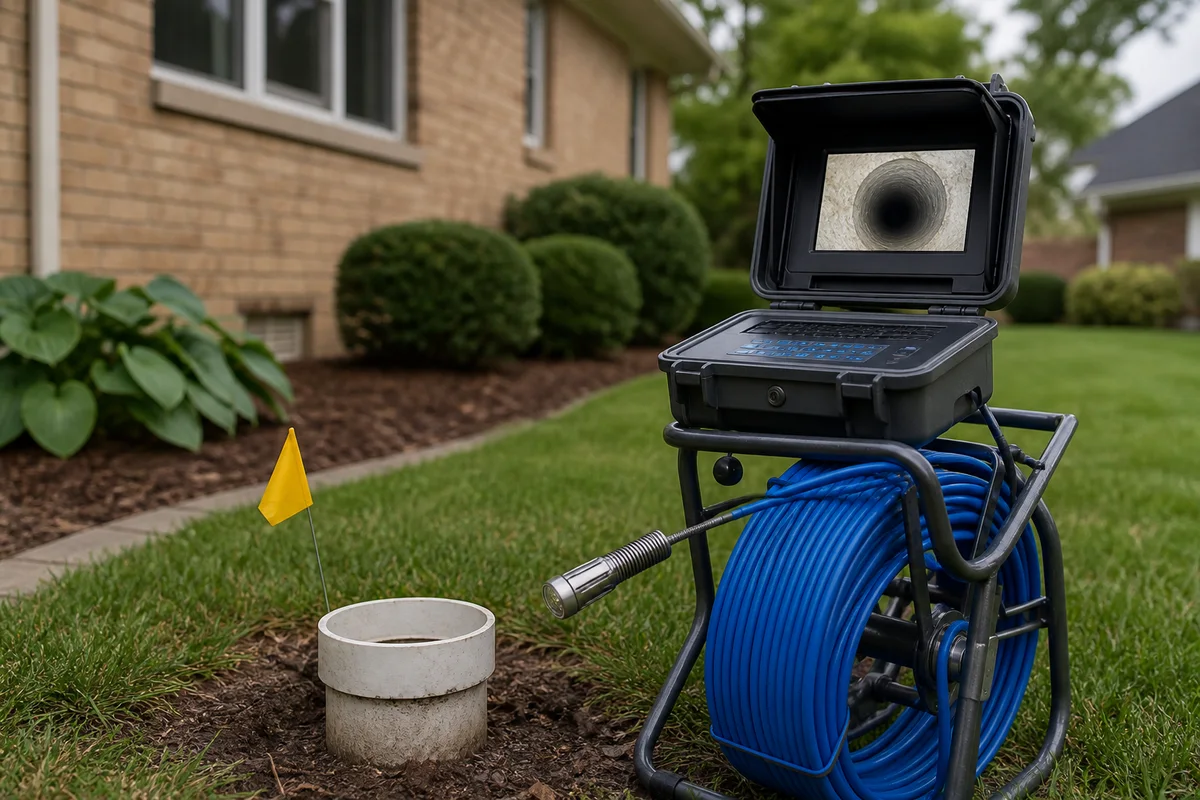
A sewer camera inspection should produce a complete recording and a written station log. Name the starting opening, camera direction, visible materials, estimated diameter, joints, branches and transitions. Tie cracks, roots, offsets and standing water to measured distances, then locate decision-critical points at the surface. A narrated video without an identifiable starting point is difficult to compare with a later proposal.
If roots or debris obscure the pipe, retain the first recording and identify what cleaning is proposed before the next pass. Cleaning can restore visibility, but removal of a blockage does not establish that the pipe wall and joints are sound. In a Clawson ranch with recurring backups, the useful question is what remains visible after cleaning and how far the survey actually reaches.
State the survey limit clearly. A camera that stops at an obstruction has not inspected the downstream route. It also cannot directly establish outside soil support, hidden utility separation or precise pipe grade. Persistent standing water may require further measurement; footage alone should not turn a suspected low section into a fully defined repair scope.
Match lining, bursting or spot repair to the observed pipe
Trenchless pipe lining needs a host pipe that can be prepared and that retains suitable geometry. The plan should explain cleaning, transitions, branch treatment and the condition of each liner endpoint. A liner follows the existing route, so an unresolved sag, inaccessible collapse or major displacement may prevent it from addressing the actual failure.
Pipe bursting replaces a run along an existing path, but requires compatible material, manageable bends, adequate separation from other utilities and room for entry and receiving pits. On Clawson’s compact blocks, draw those pits and the equipment path on the property sketch. Camera footage helps describe the old pipe; separate locating and field assessment must address surrounding utilities and displacement constraints.
A spot repair can be appropriate when the defect is isolated and serviceable pipe is documented on both sides. Ask what remains upstream and downstream, especially where an older clay run meets a previous replacement. Compare it with broader sewer line repair and replacement when several defects, poor grade or inaccessible sections make a short repair incomplete. Controlled excavation remains an option when trenchless prerequisites are absent.
Confirm Clawson permits and county involvement
Give the City of Clawson the address, camera findings, proposed method and locations of any openings. Ask which permits, inspections and right-of-way approvals apply, who obtains them, and what must remain available for inspection. If work approaches the Main Street or 14 Mile frontage, identify the actual affected surface and ask who authorizes that work rather than assuming road or utility jurisdiction.
Confirm any relevant county facility, drain or review question with Oakland County Water Resources. The Oakland County Water Resources Commissioner should not be treated as proof that the county maintains a particular private lead; responsibility needs address-level confirmation. Keep the city’s answer and any applicable county direction with the scope. No particular form or approval sequence is assumed here.
Compare the full Clawson work zone and closeout
Request written scopes based on the same footage and station log. Include cleaning, locating, access, pit locations, branch treatment, inspections, interior protection, closing footage and restoration. For a ranch lot with a paved drive or narrow side passage, clarify how equipment reaches the opening and which surfaces require reinstatement. List the conditions that could change the scope, including an unseen collapse, different material or conflicting utility.
Keep emergency flow restoration separate from the structural repair decision. After work, retain before-and-after footage, the repaired station range, material information, permit and inspection records, and restoration terms. Closing footage should show endpoints and transitions as well as flow. Any uninspected portion should remain identified in the property file rather than disappearing from the final account.
For the older bungalow setting farther south in Ferndale, compare the recorded pipe transitions and small-lot access rather than extending Clawson’s ranch-block assumptions.
Request options for a Clawson address
Send symptoms, property type, past work and available footage through the contact form. The neighboring Madison Heights, Royal Oak and Troy guides offer useful comparisons for this compact Oakland County setting, while every repair still needs its own property record. Browse all service areas and have a qualified local provider confirm field conditions and current requirements before approving a final method.
When a sewer problem surfaces in Clawson, many owners begin with emergency sewer repair in Livonia or sewer backup repair for Clawson homes before the cause is confirmed. From the same camera record you can also weigh under-slab sewer repair in Livonia, trenchless water line replacement across metro Detroit, storm drain pipe repair, and a pre-purchase sewer inspection near Livonia.
Nearby areas we serve around Clawson: trenchless sewer repair in Royal Oak, trenchless sewer repair in Troy, trenchless sewer repair in Madison Heights, trenchless sewer repair in Birmingham, trenchless sewer repair in Berkley. The same address-first camera record and method comparison apply across these communities in metro Detroit.
Frequently asked
01Does a Clawson brick ranch necessarily have its original clay sewer?
No. Original clay or cast-iron pipe is a reason to investigate, not a material diagnosis. A camera survey and available repair records must identify what is present, including later replacement sections.
02What changes when sewer work is near Main Street or 14 Mile Road?
Record the actual pipe route and affected frontage, then ask the City of Clawson which access, inspection and right-of-way requirements apply. Corridor proximity alone does not identify the utility or the ownership boundary.
03Can lining correct standing water in a Clawson lateral?
A liner follows the host pipe and does not normally correct a sag. Document the extent of standing water and obtain any needed grade measurements before treating lining as a complete repair.
04How should a Clawson homeowner compare a spot repair with bursting?
Use one measured defect log. A spot repair needs serviceable pipe on both sides, while bursting requires a suitable route, material, utility clearance and access pits. Include remaining pipe condition and restoration in both scopes.
05Should Oakland County be contacted for every Clawson private sewer repair?
Start with the City of Clawson for the exact address and scope. Confirm with Oakland County Water Resources when a county facility, drain or responsibility may be involved; do not assume county review or ownership from the city location alone.