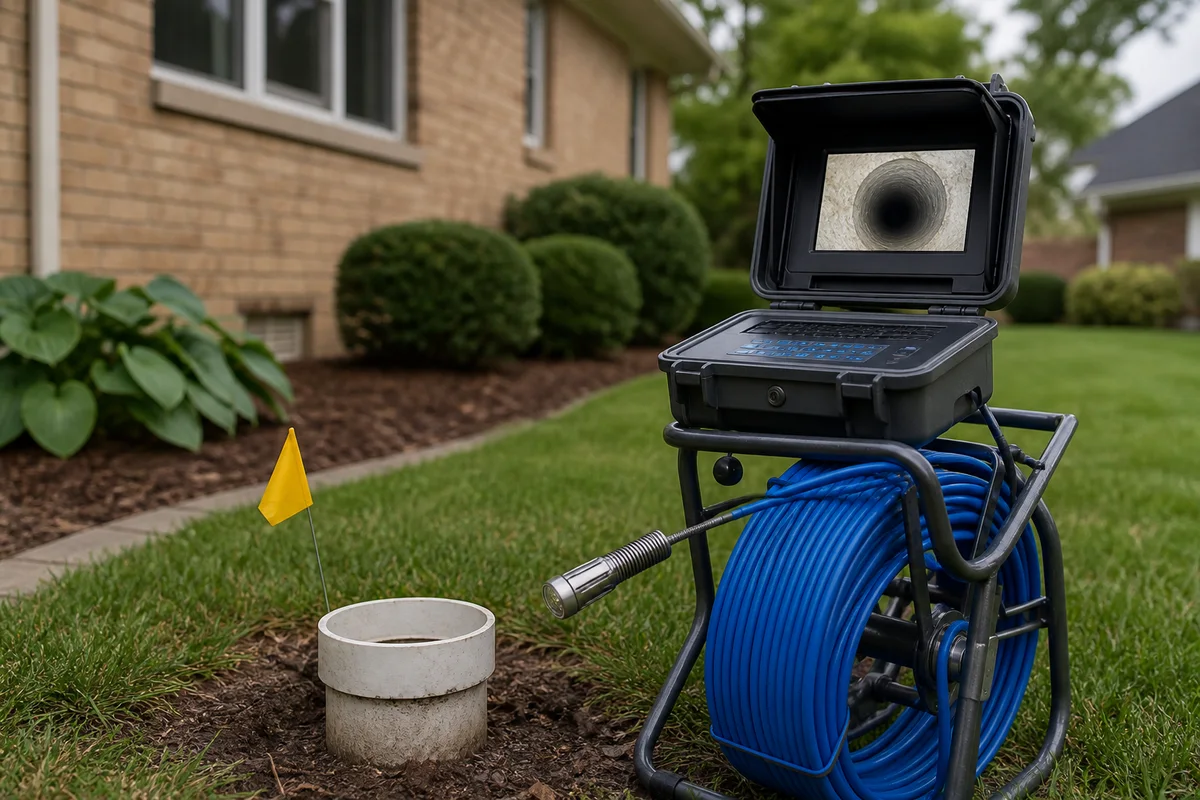
Livonia Trenchless helps Hazel Park homeowners organize sewer inspection findings and request repair options, approximately 20 miles from the Livonia hub. Hazel Park occupies the southern Oakland County edge at 8 Mile, east of Ferndale and south of Madison Heights. The I-75 and I-696 corridors provide regional context, while the repair questions usually begin much closer to home: a basement drain, an aging cleanout or a short yard crowded by walks and driveway edges.
Much of the housing context involves small-lot bungalows from the 1920s through the 1950s and postwar frame homes. Clay and cast-iron laterals may remain beneath those properties, sometimes interrupted by later repairs. Neither the home’s exterior nor its construction era tells you which pipe is present today. A sewer camera inspection establishes the visible route and condition before a provider recommends lining, replacement or a smaller intervention.
Follow the symptom from the house toward the street
Start the investigation where the trouble appears. A laundry drain that overflows when another fixture empties may require inspection of an interior connection as well as the outside lead. Repeated trouble throughout the lowest level suggests a different inspection scope from one slow fixture. Explain how the symptoms develop rather than requesting a particular repair method at the outset.
On Hazel Park’s closely built blocks, an accessible opening may be indoors, beside the foundation or elsewhere on the parcel. Ask the inspector to identify the starting point and travel direction in the recording. Confirm whether the visit includes the building drain beneath the house, the exterior lateral and the connection at the far end. Those boundaries prevent an apparently complete video from concealing an important gap in coverage.
Save earlier clearing records and repair descriptions. A previous replacement might cover only a few feet near the foundation while leaving older joints farther out. Request evidence for each remaining section instead of treating a past repair as proof that the entire route was renewed.
Treat heavy-rain backups as a separate investigation question
Older combined-sewer style backup concerns can make heavy rainfall an important part of a Hazel Park homeowner’s history. That context does not establish the serving system at a particular address or prove why water entered a basement. Record the timing of the event, the openings involved and whether normal drainage returned as rainfall eased. Identify any clearing performed during the event and whether it changed the symptoms.
Ask the serving utility about relevant downstream conditions when several properties appear affected or the trouble tracks storm timing. Keep that information alongside, rather than substituted for, the private inspection. Footage collected in dry weather can show an obstructed joint or broken pipe, but cannot recreate the hydraulic conditions present during a storm.
A repair proposal should distinguish the defect it addresses from any unresolved wet-weather concern. Sealing a root opening may be justified by clear footage without supporting a promise that every future storm backup will stop. Obtain address-specific direction on any additional protective measures before assuming a structural lateral repair answers the whole basement problem.
Make root entry visible before defining the repair length
Established street trees and older sewer joints deserve attention together, but tree proximity alone is weak evidence. The useful finding is a root entry point inside the pipe, tied to a measured distance and surface location. Document whether intrusion occurs at a single joint, several joints or a transition between materials.
Tree root removal may restore passage for a camera and improve drainage. Follow it with footage showing the newly exposed pipe walls and joint edges. Cutting roots does not close the opening that admitted them, and a successful flush does not demonstrate that the surrounding lateral can support a liner.
Hazel Park’s modest yard dimensions make accurate defect locations especially valuable. A finding near a front walk can require a different access arrangement from one beside a foundation. Preserve the actual distances rather than rounding several separate defects into one general description of a bad sewer. If water or remaining debris blocks the view, carry that limitation into the next investigation step.
Fit the work area to the bungalow lot
An inspection route and a construction route are different practical questions. Note gates, fences, steps, parked vehicles, overhead obstructions and the width available beside the house. Show where equipment, removed material and replacement pipe would go. Permission to work at one address does not supply access across a neighboring parcel.
For a small Hazel Park lot, ask for a plan that places each proposed opening relative to the home and existing improvements. Include the basement access arrangements if the method requires interior work. A narrow driveway may permit one piece of equipment while leaving inadequate room for pipe handling or safe movement around an opening.
Discuss restoration at the same time as access. Record which walk sections, driveway edges, planting beds or fence panels the scope affects and who reinstates them. A trenchless method can reduce continuous digging while still requiring substantial work at endpoints, branches or a defective connection. Compare the actual footprint on your parcel rather than a generic description of a small excavation.
Use camera evidence to qualify lining and bursting
Trenchless pipe lining can be considered when cleaning exposes a host pipe with suitable shape and a continuous passage. Have the provider explain how the chosen endpoints relate to the observed root joints and material changes. Any branch connection needs an explicit treatment plan, including how service will be retained or restored.
A liner takes the route of the existing pipe. Persistent standing water, a severe offset or a collapse calls for further evaluation before lining is selected. Ask what the camera shows, what remains concealed and whether additional measurements are needed to understand the pipe’s geometry. A video image alone does not establish precise slope or the support outside the pipe wall.
Pipe bursting requires a workable replacement path, compatible existing material and sufficient room for displacement and equipment. Separate utility locating and field evaluation are needed to assess nearby facilities. Camera footage identifies features inside the sewer; it does not prove safe clearance outside it. On Hazel Park’s compact parcels, both pit placement and the path used to introduce new pipe can determine feasibility.
Where the damage is confined, discuss a spot repair with documented serviceable pipe on either side. Compare trenchless sewer replacement and sewer line repair and replacement when multiple failures or unsuitable geometry make a shorter treatment incomplete. Excavation remains an option when it directly addresses a condition that lining or bursting cannot resolve.
Confirm authority and keep a usable completion file
Contact the City of Hazel Park with the property and proposed scope to confirm the applicable permits, inspections and responsibility boundary. Describe any opening near the public frontage and identify who will obtain approvals. If a county facility is involved, establish the relevant Oakland County coordination before work begins. A Livonia or Wayne County practice does not establish the requirements for a Hazel Park connection.
Compare proposals using one common inspection record. Include preparation, access, pipe treatment, connection work, utility coordination, inspection and restoration. Ask how a concealed obstruction or changed material would alter the scope. After completion, retain footage showing the treated locations and endpoints, the written work description, applicable inspection records and any unexamined sections still needing attention.
Use the contact form to share your symptoms, prior work and available video. Nearby guides for Ferndale, Madison Heights and Royal Oak provide further Oakland County context. Each Hazel Park property still needs its own findings, measured access plan and method assessment. The service area directory covers the broader Oakland and Wayne County communities served by these homeowner guides.
When a sewer problem surfaces in Hazel Park, many owners begin with emergency sewer repair in Livonia or sewer backup repair for Hazel Park homes before the cause is confirmed. From the same camera record you can also weigh under-slab sewer repair in Livonia, trenchless water line replacement across metro Detroit, storm drain pipe repair, and a pre-purchase sewer inspection near Livonia.
Nearby areas we serve around Hazel Park: trenchless sewer repair in Ferndale, trenchless sewer repair in Madison Heights, trenchless sewer repair in Royal Oak, trenchless sewer repair in Oak Park, trenchless sewer repair in Warren. The same address-first camera record and method comparison apply across these communities in metro Detroit.
Frequently asked
01Can a camera survey explain why only the Hazel Park basement laundry drain overflows?
Trace the laundry branch and its connection before assuming the exterior lateral is responsible. Record whether other fixtures trigger the overflow. A survey of the yard pipe alone may miss a restriction in the interior branch, so define the inspection route around the actual symptom.
02What if roots hide the joint where my sewer changes material?
Request controlled cleaning followed by another camera pass at that location. The repair decision needs a visible transition and surrounding pipe condition; if visibility cannot be restored, the proposal should explain how that uncertainty will be investigated before treatment.
03How should a Hazel Park proposal handle a fence beside the access route?
Identify the required working width and whether a panel, gate or other improvement must be temporarily removed. Assign removal and reinstatement in the written scope, and confirm property boundaries before using space beyond your own lot.
04Is an inspection complete if the camera stops before the public connection?
It is a limited survey. Keep the stopping distance, reason for stopping and unexamined section in the report. Ask whether another access point or further investigation is needed before accepting a repair that depends on the unseen connection.
05Which observations help separate rain-related concerns from everyday drain trouble?
Keep a dated record of rainfall timing, household water use, affected openings and whether drainage returns without clearing. Share it with the inspector and serving utility when appropriate. These observations guide follow-up but do not independently identify a private defect or downstream capacity problem.