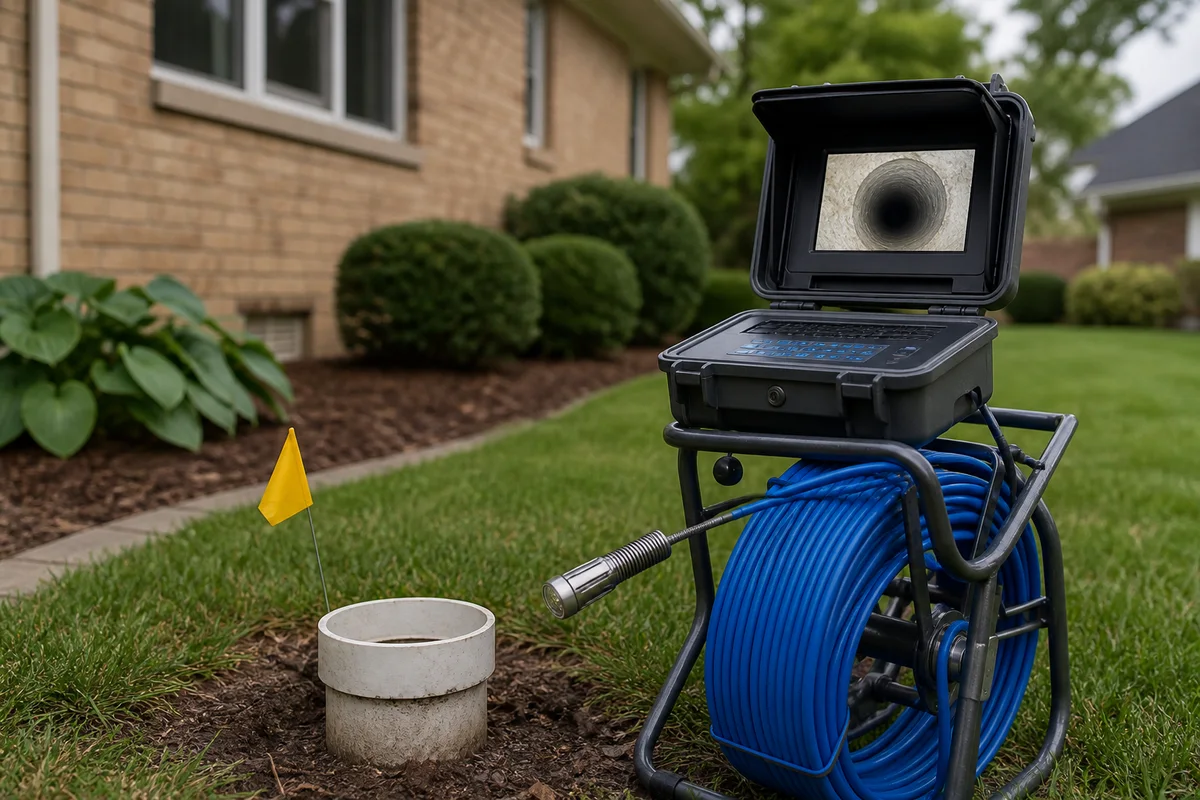
Livonia Craft Trenchless is a Livonia, Michigan information and quote-request resource focused on camera-led sewer decisions. Hydro jetting pushes a pressurized water stream through the pipe to scour the full wall, which is a different result from a cable or auger that punches a channel through the center of a blockage and leaves the surrounding buildup in place. Jetting often clears the obstruction behind an emergency sewer repair in Livonia call, and the same equipment can scour a clogged line during storm drain pipe repair across metro Detroit.
The City of Livonia reports that it maintains about 540 miles of sanitary sewer and that the private sewer lead and its connection to the main remain the homeowner’s responsibility. That boundary makes a precise defect station and a clear ownership record essential before hydro jetting is proposed.
Confirm the blockage type before jetting
Start with station zero. Record the access opening, direction of travel, pipe material, approximate diameter, distance counter, visibility, and every point where the material or geometry changes. The continuous recording should show the approach to each defect, not only a screenshot of the worst frame.
A jetting record should name the blockage before the method is chosen. Grease forms a coating that narrows the bore and can stack into a near-solid plug near a kitchen branch. Scale builds on an interior cast-iron wall and hardens over time. Roots enter at a failed joint, crack, or open connection and can fill the bore with a dense mat. Sediment settles on a low or poorly graded run. Each condition responds differently to a water stream, and a single camera pass that stops at the first obstruction cannot distinguish them from the surface description alone.
Snaking and jetting are not interchangeable records. A cable clears a path large enough for flow to return and for a camera to pass, but it does not scour the wall the way a rotating or penetrating nozzle can. If deposits, standing water, roots, scale, or an obstruction hide the wall, label the first pass as limited. A post-cleaning pass is a different record and should not be confused with the first survey.
Convert the video into a station log
For each observation, write the distance, clock position where useful, surrounding sound-pipe condition, severity, and the action needed to qualify it. Surface-locate the stations that can alter access, method, cost, or restoration. Photograph the marks beside fixed references such as the foundation, cleanout, walk, drive, curb, or property boundary.
The camera operator should state the end of the inspected route and why the survey stopped. A line that could not be viewed to the connection remains partly unknown, even when the visible footage looks clear.
Match nozzle and pressure to the pipe material
Use one condition record to compare camera inspection, tree root removal, CIPP lining, sewer line repair and replacement, and controlled excavation where those choices remain relevant. The recommendation should explain which prerequisite each option satisfies or fails.
Livonia and the surrounding Metro Detroit suburbs include substantial mid-century clay and cast-iron lateral stock, along with the bituminized-fiber pipe sometimes identified by the Orangeburg name. A nozzle and pressure setting suited to sound clay or cast iron is not automatically appropriate for a pipe that is already blistered, flattened, or delaminating. Method limits belong in the written scope. If later cleaning, locating, or access work changes a qualifying fact, the proposal should pause at a named decision point rather than changing the method informally in the field.
Put preparation and access into the method comparison
Preparation is part of the repair, not a side task. Compare cleaning, descaling, root cutting, locating, pits, interior protection, bypass or flow control, branch treatment, utility marking, inspection, and restoration on the same line-by-line sheet. A lower method price can omit a required preparation item and still produce a higher final cost.
Equipment placement also matters in Livonia’s established residential blocks. Mature trees, driveways, patios, fences, attached garages, finished basements, and long setbacks can control the work zone even when the obstruction itself is confined to a short section of pipe.
Decide whether jetting is maintenance or prep for lining
Jetting serves two different purposes, and a proposal should say which one applies. As standalone maintenance, jetting restores flow and extends the interval before a grease or scale condition returns, without changing the structural condition of the pipe. As preparation, jetting is the cleaning step that gets a host pipe clean enough for a camera to confirm its condition and, where the route qualifies, for a resin liner to bond against the wall during trenchless pipe lining. Treating a prep pass as if it were a permanent fix, or a maintenance pass as if it already proved the pipe is lining-ready, both misrepresent the record.
Recognize when jetting is not the answer
A collapsed section, a severe offset, a belly that keeps retaining water and solids, or a pipe already weakened by material failure is not corrected by clearing it. If a sewer backup keeps recurring after repeated cleaning at the same station, that pattern itself is evidence that a structural defect, not ordinary buildup, is the underlying cause, and the next step is a camera-documented comparison with sewer line repair and replacement rather than another cleaning visit.
Permits and utility checks before equipment arrives
Wayne County publishes separate guidance for connections or alterations involving county sanitary interceptors, while Livonia’s Inspection Department handles local plumbing permits and inspections. A private residential repair is not automatically the same as a county-interceptor project. Confirm the current authority for the actual address and proposed scope before work begins.
The written plan should identify who obtains permits, who schedules inspections, what needs to remain visible, and what closes the permit. It should also distinguish the private building sewer from the public main and any shared or commercial piping on the parcel. Homeowners in nearby Garden City face the same mid-century material questions, so the same evidence standard applies before cleaning equipment is scheduled there.
Check the route against Livonia utility information
Livonia’s public GIS resources include sanitary sewer, storm-drain, water-main, parcel, and right-of-way layers. Those records can provide context, but they do not replace private locating or camera evidence. A map line is not proof of private material, depth, or condition.
Before equipment is staged or ground is opened, complete utility marking and verify sensitive crossings. A presumed straight lateral can include bends, repairs, or an unexpected connection that changes the practical approach.
Cost drivers for hydro jetting in Livonia
Cost follows the measured work zone. Important variables include footage, depth, diameter, access, the blockage type, material condition, branch count, equipment position, soil and groundwater, utility conflicts, permits, inspection, traffic control, interior protection, and the certainty of the camera record.
The City of Livonia publishes plumbing permit information and fee schedules, but a permit line is only one part of the total scope and current fees should be confirmed at application time. Use the Livonia sewer repair cost guide to compare inclusions rather than treating a web page as a remote property quote.
Compare exclusions and change conditions
Ask each proposal to identify allowances, unit prices, owner responsibilities, exclusions, and the evidence that would trigger a change. The comparison should say what happens if the camera cannot pass, cleaning reveals a larger defect, the route is not where expected, a utility conflict appears, or the selected method cannot reach the planned endpoint.
A complete bid also names what happens if jetting alone does not restore flow, and whether the quoted price already assumes a second visit, a different nozzle, or an escalation to a structural method.
Verify the cleared pipe and plan for recurrence
Closeout should refer to the same access point and defect stations used to approve the work. Preserve the full post-cleaning camera pass, the blockage type identified, permit and inspection records where applicable, and any limitation that remains beyond the cleaned section.
Clearing the pipe does not seal the opening that admitted roots, and it does not remove the upstream source of grease. Without addressing the entry joint or the contributing use, the same blockage can reappear on a predictable interval. A written record of the interval and the recurring station helps distinguish a maintenance pattern from a structural defect that needs a different method.
Request hydro jetting options
Use the request form to send the Livonia-area property location, system type if known, symptoms, prior repair information, and any available footage. This website provides planning information and routes quote requests. A qualified local provider must inspect the property before issuing a final scope.
Primary references for this hydro jetting guide
- City of Livonia Water and Sewer
- Wayne County environmental permit guidance
- U.S. EPA trenchless rehabilitation fact sheet
Areas we serve across Wayne, Oakland and Macomb County in metro Detroit. Wayne County: sewer repair in Livonia, sewer repair in Garden City, sewer repair in Redford, sewer repair in Westland, sewer repair in Northville, sewer repair in Plymouth, sewer repair in Inkster, sewer repair in Plymouth Township, sewer repair in Dearborn Heights, sewer repair in Wayne, sewer repair in Canton, sewer repair in Dearborn. Oakland County: sewer repair in Farmington, sewer repair in Farmington Hills, sewer repair in Southfield, sewer repair in Novi, sewer repair in Oak Park, sewer repair in Royal Oak, sewer repair in Berkley, sewer repair in Birmingham, sewer repair in Ferndale, sewer repair in Troy, sewer repair in Hazel Park, sewer repair in Madison Heights, sewer repair in Clawson, sewer repair in Rochester Hills. Macomb County: sewer repair in Warren, sewer repair in Sterling Heights.
Frequently asked
01What evidence should come before hydro jetting?
Keep the complete camera record, access point, direction, measured stations, pipe material and diameter, the specific blockage type, and the reason jetting was selected over snaking or another method.
02Can hydro jetting still require excavation?
Yes. A collapsed section, severe offset, fragile pipe, or a defect the jetting nozzle cannot safely clear may still require a controlled opening instead of, or after, cleaning.
03Is hydro jetting safe on Orangeburg or other fragile pipe?
Not automatically. A camera should confirm pipe material and condition first, because pressure appropriate for sound clay or cast iron can further damage a pipe that is already deformed or delaminating.
04What records should remain with the property after jetting?
Retain the pre-cleaning and post-cleaning footage, the station log, the blockage type identified, and any recommendation that followed, including lining or repair.
05Does hydro jetting stop roots or grease from returning?
Not by itself. Jetting clears the pipe at the time of service. Roots return unless the entry joint is sealed or lined, and grease can rebuild unless the contributing source and routine maintenance are addressed.