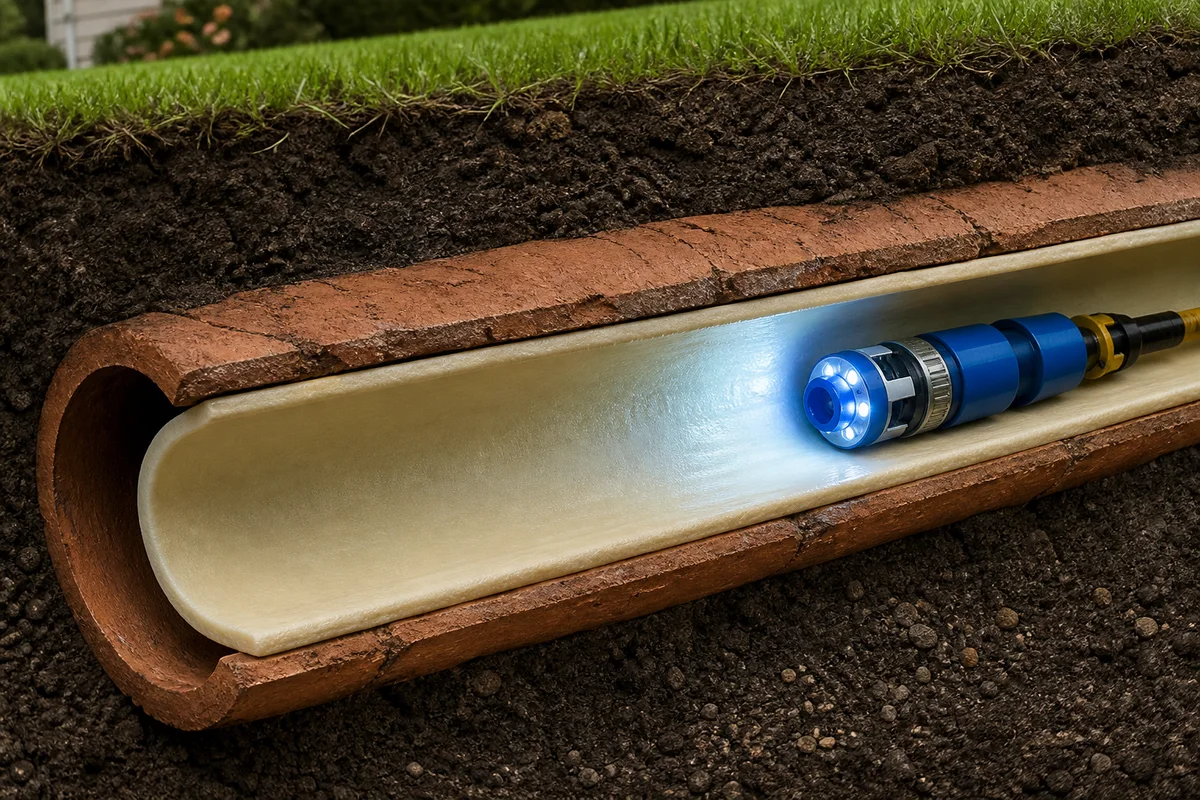
Livonia Craft Trenchless is a Livonia, Michigan information and quote-request resource focused on camera-led sewer decisions. Epoxy pipe lining starts with the condition of the homeowner lateral, not a promise that resin can fix any buried pipe. A suitable resin-and-liner system can form a new pipe inside a prepared clay or cast iron route while reducing excavation through the yard or driveway.
For a Livonia home, the useful question is what the proposed epoxy system will accomplish at the measured defect stations. The answer needs a continuous camera record, a preparation plan, product identification, and a way to verify the cure. This guide focuses on resin selection and installation controls for private sewer laterals in Livonia, Wayne County, and Metro Detroit.
Separate epoxy resin from the CIPP method
Epoxy is a resin chemistry. Cured-in-place pipe, or CIPP, is a rehabilitation method that places a resin-saturated liner inside the host pipe and cures it in position. An epoxy system may be used for that method, but the words are not interchangeable. Other resin systems also exist, and a bid that says only “epoxy treatment” leaves too much unspecified.
The trenchless pipe lining guide covers the broader CIPP method: access, placement, route suitability, branches, and endpoints. On this page, the decision turns on what resin and liner are proposed, how they are prepared and cured, and what records demonstrate that the installed system matches the scope.
Ask whether the proposal is for a structural liner or a surface coating. A coating claim does not establish the structural performance of a designed liner. Require the provider to explain the system’s intended use, design basis, thickness, host-pipe assumptions, and limitations before accepting either description.
Establish the lateral condition before selecting resin
Start with a sewer camera inspection that identifies the access opening, direction of travel, material, diameter, and distance stations. Preserve the full recording through the visible route. A close-up of a crack cannot show whether the camera passed a sag, a displaced joint, or an unrecorded branch on the way there.
Clay laterals may show roots at joints, cracks, or offsets. Cast iron may carry scale that hides corrosion or loss along the bottom of the pipe. Record material transitions, bends, existing repairs, and the proposed downstream endpoint. If water or deposits hide the wall, label that section as unverified and require another pass after appropriate preparation.
A liner follows the existing route. It does not lift a belly, restore missing slope, or straighten a severe offset. Where a collapse or unstable section prevents controlled placement, compare sewer line repair and replacement against lining the remaining suitable section. The scope should identify what evidence would change the recommendation.
Prepare clay joints and cast iron surfaces deliberately
Resin selection cannot compensate for roots, loose scale, grease, or debris left in the work zone. Preparation must create the conditions required by the selected system without assuming that every old pipe can tolerate the same cleaning equipment or intensity.
For clay, document root entry locations and joint geometry after cleaning. For cast iron, expose enough of the surface to assess the invert, fittings, and remaining passage. The cast iron pipe lining guide explains why the post-descaling condition matters more than the appearance of the initial camera pass.
A hydro-jetting plan should state its cleaning objective, access, debris handling, and limits for the observed pipe. Mechanical preparation may also be needed where appropriate to the material and system. Keep the initial and post-cleaning recordings separately so the homeowner can see what preparation revealed. If the cleaned pipe fails the proposed system’s requirements, revisit the method before resin is mixed.
Put resin handling and cure evidence in writing
A useful epoxy proposal identifies the resin manufacturer and product, compatible liner construction, installation procedure, and cure method. Ask how the crew controls storage conditions, mixing ratio, batch identification, working time, and placement. These details connect the product’s requirements to the actual lateral rather than to a generic sales description.
Temperature and time matter to epoxy curing, but there is no single cure schedule for every product or property. Require the installer to follow the selected system’s documented procedure and record the conditions it requires. A statement that the resin “felt hard” is not a substitute for the applicable cure record and acceptance criteria.
The scope should also address groundwater or active flow, household sewer restrictions, equipment placement, and the point when service can resume. Ask who communicates the no-use window and how fixtures will be protected from accidental discharge during installation. Product-specific handling and ventilation measures belong in the provider’s work plan, especially when access is through a basement.
Reject DIY pour-down epoxy kits
Do not pour epoxy into a sewer drain as a homeowner repair. A pour-down kit cannot place a designed liner at a measured station, hold a controlled wall thickness, protect branch openings, or document a cure throughout a buried lateral. Material can collect where it is unwanted and leave the original defect unresolved.
Professional lining involves controlled placement and verification inside a qualified host pipe. A recurring backup needs evidence about its cause before any repair is selected. Cleaning may restore flow while leaving a joint defect; a liner may address a suitable damaged section while leaving a grade problem unchanged. Keep those outcomes distinct when reviewing a recommendation.
Define access and connections for a Livonia property
Established Livonia properties can have finished basements, attached garages, mature trees, patios, and driveways along the sewer route. Confirm where equipment enters the lateral, whether a cleanout is usable, and whether a controlled opening is needed. “Trenchless” does not remove the need to describe access and restoration.
The plan should locate liner endpoints and explain how active branches or connections remain open. It should distinguish the private lateral from the public main and identify any section outside the repair. Confirm the applicable permit and inspection requirements for the Livonia address and scope, including who obtains approvals and keeps the closeout records.
For nearby Wayne County properties such as Westland, use the same camera-led process while confirming the authority for that address. Metro Detroit proximity does not make one property’s access, connection details, or approval requirements transferable to another.
Compare complete scopes and retain the cured-pipe record
Compare proposals using the same measured footage and endpoints. Relevant cost drivers include diameter, preparation, material transitions, liner design, resin system, cure equipment, access, branch work, inspections, and restoration. Ask each provider to identify exclusions and the conditions that require a revised scope. A short resin description alone is not a complete bid.
Closeout should include the full post-work camera pass tied to the original station log. Review the visible bore, endpoints, transitions, and any reinstated openings. Camera footage documents visible condition; it does not independently prove resin chemistry or cure quality. Keep product identification, preparation notes, required cure records, acceptance results, and applicable inspection signoffs alongside the video.
Request written warranty terms that identify the responsible company, coverage, exclusions, and claim process. Retain any limits beyond the lined section with the property records. Use the request form to share the Livonia-area address, backup history, known material, and available footage. A qualified local provider must inspect the lateral before issuing a final epoxy lining scope.
Areas we serve across Wayne, Oakland and Macomb County in metro Detroit. Wayne County: sewer repair in Livonia, sewer repair in Garden City, sewer repair in Redford, sewer repair in Westland, sewer repair in Northville, sewer repair in Plymouth, sewer repair in Inkster, sewer repair in Plymouth Township, sewer repair in Dearborn Heights, sewer repair in Wayne, sewer repair in Canton, sewer repair in Dearborn. Oakland County: sewer repair in Farmington, sewer repair in Farmington Hills, sewer repair in Southfield, sewer repair in Novi, sewer repair in Oak Park, sewer repair in Royal Oak, sewer repair in Berkley, sewer repair in Birmingham, sewer repair in Ferndale, sewer repair in Troy, sewer repair in Hazel Park, sewer repair in Madison Heights, sewer repair in Clawson, sewer repair in Rochester Hills. Macomb County: sewer repair in Warren, sewer repair in Sterling Heights.
Frequently asked
01Is epoxy pipe lining the same as CIPP?
Epoxy describes a resin chemistry; cured-in-place pipe describes the installed liner method. An epoxy resin can be used in a CIPP system, but the proposal must identify the complete liner system and its design.
02Can epoxy lining repair clay and cast iron laterals?
A qualified system may suit prepared clay or cast iron when inspection confirms a usable route, suitable geometry, and appropriate endpoints. Collapse, severe offsets, and poor grade can require another repair method.
03Will a DIY pour-down epoxy kit fix a buried sewer?
No. A pour-down kit does not provide controlled liner placement, thickness, branch protection, or documented curing. Do not pour resin into a sewer lateral; obtain a camera-led professional assessment.
04Does epoxy lining eliminate excavation?
It can reduce excavation along a suitable lateral, but access openings, connection work, or a failed section may still require digging. The written scope should identify those locations and restoration responsibilities.
05What should an epoxy lining closeout include?
Keep the before-and-after camera recordings, measured endpoints, liner and resin identification, preparation and cure records, applicable inspection signoffs, and written warranty terms.